
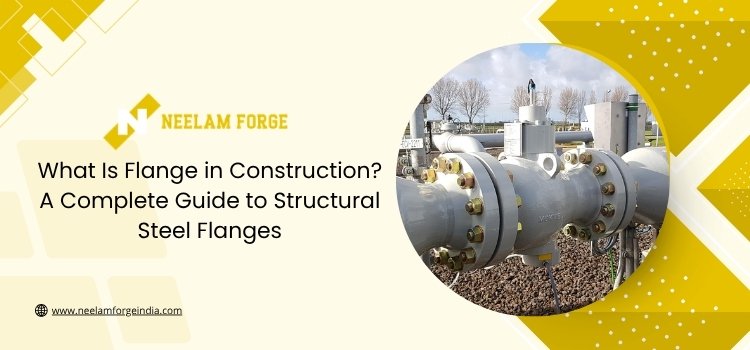
Understanding the Role of Flanges in Piping and Construction Projects
What Is a Flange in Construction? A Complete Guide to Pipe Flanges. This is one of the most common questions engineers, contractors, and procurement teams ask when specifying piping systems for industrial and construction projects. A flange is a forged fitting, typically a flat disc or ring, that connects pipes, valves, pumps, and other equipment to form a piping system, and allows for easy access when cleaning, inspection, or modification is needed.
Flanges are bolted together with a gasket in between to create a leak-tight seal capable of withstanding high pressure and temperature. In construction and industrial piping, knowing how flanges work, the types available, and how to size them correctly is essential for safety, cost control, and long-term system reliability. This guide covers what a flange is, the common types used in construction, and how to choose the right one for your project.
The Role of Flanges in Piping Systems
Flanges serve as the connection points in a piping system, joining sections of pipe to each other or to equipment such as pumps, valves, and tanks. Unlike welded joints, flanged connections can be disassembled for maintenance, inspection, or replacement without cutting into the pipeline. This makes flanges essential wherever a piping system needs to be serviceable over its working life, particularly in oil and gas, chemical processing, water treatment, and structural steel piping applications.
Flange vs Weld Joint: Which Should You Use?
It is important to understand when a flanged connection makes more sense than a direct weld joint:
- Flange: Bolted, removable, ideal for maintenance access and equipment connections.
- Weld Joint: Permanent, used where disassembly is never required.
Flanges add a small amount of cost and installation time compared to a direct weld, but the ability to service the line without cutting pipe usually justifies that cost in any system that will need inspection, cleaning, or component replacement over its lifetime.
Purpose of a Flange in Piping Construction
The purpose of a flange in piping construction goes beyond simply joining pipe sections. Key functions include:
- Providing a leak-tight, bolted connection between pipe sections
- Allowing easy access for maintenance, cleaning, and inspection
- Connecting pipe to valves, pumps, and other equipment
- Withstanding internal pressure and thermal expansion in the line
In heavy industrial and construction projects, such as refineries and process plants, flanges are engineered to handle both static pressure and dynamic loads over decades of service.
Common Types of Flanges Explained
Several flange types are used depending on the application, pressure rating, and ease of installation required. The most common types include:
- Weld Neck Flange: Has a tapered hub welded directly to the pipe, ideal for high-pressure and high-temperature service.
- Slip-On Flange: Slides over the pipe and is fillet welded, easier and faster to install than weld neck.
- Blind Flange: Used to seal off the end of a piping system or a pressure vessel opening.
- Lap Joint Flange: Used with a stub end, allows the flange to rotate for easier bolt alignment.
Flange Dimensions and Standards: Why They Matter
Flange dimensions, including outside diameter, bolt circle, thickness, and bolt hole spacing, are governed by international standards to ensure compatibility between components from different manufacturers.
| Standard | Region | Typical Application |
|---|---|---|
| ASME B16.5 | North America / Global | NPS 1/2 to 24 pipe flanges |
| ASME B16.47 | North America / Global | Large diameter flanges (NPS 26–60) |
| EN 1092-1 | Europe | Metric pipe flanges |
| JIS B2220 | Japan | Metric pipe flanges |
Specifying the correct standard, pressure class, and facing type (such as raised face or flat face) is critical. A mismatch between flange standards on either side of a connection can lead to bolt hole misalignment or an improper seal, so verifying compatibility before ordering is a step worth double-checking on every project.
How Pressure Class Affects Flange Selection
Flanges are rated by pressure class, most commonly expressed in the ASME system as 150#, 300#, 600#, 900#, 1500#, and 2500#. The right class depends on the maximum operating pressure and temperature of the system:
- Higher pressure classes use thicker flanges and larger bolt circles
- Material selection (stainless steel, duplex, alloy) also affects the pressure-temperature rating
- Under-specifying pressure class is a common and costly design error
Working with your piping engineer or supplier to confirm the correct pressure class before fabrication avoids expensive rework later in the project.
Conclusion
Flanges are a foundational component in piping construction, providing a serviceable, leak-tight connection between pipe sections and equipment. Understanding the different flange types, the standards that govern their dimensions, and how pressure class affects selection will help engineers and procurement teams specify the right flange for a safe, reliable, and cost-effective piping system.
Choosing the correct flange type and standard from the start reduces the risk of installation delays, mismatched connections, and unplanned downtime once the system is in service.
FAQs
Q1. What is the difference between a weld neck flange and a slip-on flange?
A weld neck flange has a tapered hub that is butt-welded to the pipe, making it stronger and better suited to high-pressure or high-temperature service. A slip-on flange slides over the pipe end and is fillet welded in place, which is faster and cheaper to install but generally rated for lower pressure applications.
Q2. How do I know which flange pressure class I need?
Flange pressure class is determined by the maximum operating pressure and temperature of your piping system, along with the flange material. Your piping engineer typically calculates this using pressure-temperature rating tables specific to the flange standard and material grade being used.
Q3. Can flanges from different standards be bolted together?
Generally, no. Flanges made to different standards, such as ASME B16.5 and EN 1092-1, often have different bolt circle diameters and bolt hole counts, which can prevent a proper seal. It is important to confirm both sides of a connection follow the same standard and pressure class before ordering.
Looking for high-quality flanges with precise dimensions for your next piping or construction project? Contact us today or email us at sales@neelamforgeindia.com to speak with our fabrication experts and get customized solutions that meet your engineering and performance requirements.