
Understanding the Role of Blind Flanges in Piping Systems
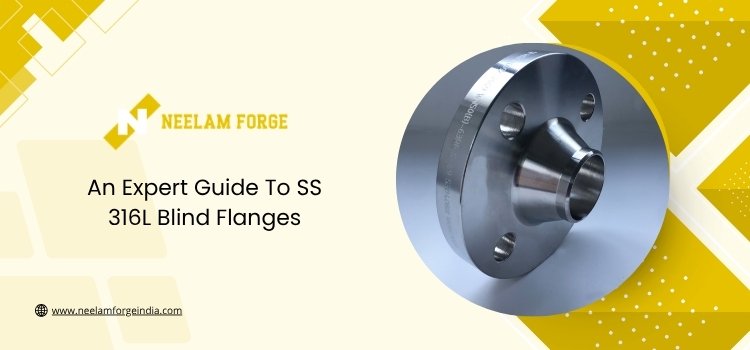
A blind flange is a component that is required in every piping system to seal the end of a line, and that’s exactly what SS 316L blind flanges do. Unlike other flange types, which are used to join two pipes in a pipeline, a blind flange is a solid disc that is installed to close the end of a pipeline, valve opening, or pressure vessel. These stainless steel flanges, made of 316L, offer excellent corrosion resistance and are a popular option for use in a wide range of industries, including chemical processing, marine engineering, pharmaceuticals, and food-grade applications. This guide covers material properties, dimensional standards, pressure ratings, and sourcing considerations to help you choose blind flanges for your next project.
316L Stainless Steel Properties That Matter
316L signifies “low carbon” and a small change with a big impact. During welding, carbide precipitation at the grain boundary of 316 stainless steel can weaken the corrosion resistance in the heat-affected zone. The properties of 316L stainless steel are optimized to resist this sensitization process, making the alloy much more reliable for welded flange assemblies, where the carbon content is kept below 0.03%.
Key characteristics include the following:
- Excellent resistance to chlorides, acids, and marine environments
- Good weldability with minimal risk of intergranular corrosion
- Retains strength and ductility across a wide temperature range
- Non-magnetic in the annealed condition, useful for specialized industries
For this reason, 316L is preferred over the standard 304 and even the regular 316 grades in harsh environments or hygienic applications.
ASTM A182 F316L Flange: The Material Standard
If you place an order for a real ASTM A182 F316L flange, you are ordering a material that has been forged and tested to a high standard and meets international requirements. Forged or rolled alloy and stainless steel pipe flanges, fittings, and valves designed to be used at high temperatures are covered by ASTM A182. The F316L designation indicates low-carbon chemistry, and minimum mechanical testing for tensile strength, yield strength, elongation, and hardness is required. A good manufacturer will always provide mill test certificates (MTCs) with the heat number so that engineers can be sure the flange is chemically and mechanically correct before it makes its way to the job site.
Flange Pressure Rating Explained
Under ASME B16.5, flange pressure rating dictates the internal pressure the flange can sustain at a specified temperature and is generally expressed in classes 150, 300, 600, 900, 1500, and 2500. The higher the temperature, the lower the pressure for a given class will be, and it’s important to compare the rating with the actual operating pressure of the system, not the maximum design pressure. Class 300 316L blind flange, for instance, could be capable of withstanding much lower pressure at 400°C than it does at ambient temperatures. Before placing a purchase order, always refer to the manufacturer’s pressure-temperature chart.
Flange Dimensions and Standard Compliance
Flange dimensions cannot be compromised because a slight mismatch in bolt circle diameter, outside diameter, or thickness compromises a seal. The majority of SS 316L blind flanges are produced in accordance with ASME B16.5 (NPS 1/2–24) or ASME B16.47 (larger sizes) that standardizes:
- Outside diameter (OD) and bolt circle diameter (BCD)
- Number and size of bolt holes
- Raised face height and diameter
- Overall flange thickness by pressure class
When the dimensions match the known standard, you know that the flanges, valves, and gaskets will all be compatible and mate together at all points in your pipe system, whether they’re from different manufacturers.
Choosing the Right Flange Supplier
A few flange suppliers do not have the same quality control measures, and this can be a costly compromise. A good supplier should offer the following:
- Full material traceability and mill certificates
- In-house or third-party testing (hydrostatic, dye penetrant, ultrasonic)
- Compliance documentation for ASTM, ASME, and relevant industry standards
- Consistent lead times and proper packaging to prevent surface contamination during transit
The selection of the appropriate grade and rating is essential for 316L stainless steel flange products, but it is also crucial to select a supplier who has the experience and is transparent about their operations when the products may be involved in critical applications with significant consequences.
Conclusion
When it comes to sealing pipes and keeping them safe and corrosion-resistant, a small but mighty part plays a big role: The SS 316L blind flange. The knowledge of the low-carbon chemistry of the properties of 316L stainless steel, verifying ASTM A182 F316L certification, matching the correct flange pressure rating, and confirming precise flange dimensions all have an impact on the long-term reliability of your installation. When selecting a flange supplier, these considerations are all tied together, and you will have a component that you install that will perform just as specified in real operating situations.
FAQs
Q1. What is the difference between a 316 and a 316L stainless steel flange?
The primary difference is in the carbon content. The maximum carbon content of 0.03% for a 316L stainless steel flange helps to minimize the possibility of carbide precipitation on welding and enhances corrosion resistance in the heat-affected zone in comparison to standard 316.
Q2. How do I determine the correct flange pressure rating for high-temperature service?
Refer to ASME B16.5 tables for the pressure-temperature ratings of your particular material grade; choose a class that has a pressure rating at your max operating temp that is equal to or higher than your system’s design pressure.
Q3. Are ASTM A182 F316L flanges suitable for food and pharmaceutical applications?
ASTM A182 F316L flanges are indeed very popular in the food and pharmaceutical processing industries due to their high corrosion resistance, ease of cleaning, and adherence to sanitary piping standards when finished.
Ready to source certified SS 316L blind flanges for your next project? Connect with a trusted flange supplier who can provide full material traceability, testing documentation, and on-time delivery. Contact us or email us at sales@neelamforgeindia.com to get a quote today.