
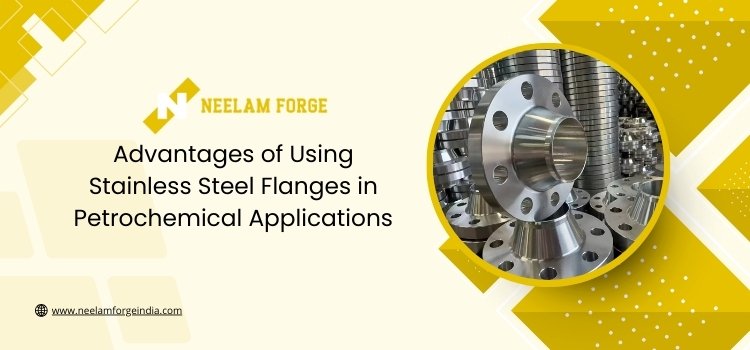
Why Stainless Steel Flanges Are Critical for Modern Petrochemical Applications?
In complex and hazardous settings such as refineries, chemical processing plants, and oil and gas facilities, it is essential to adhere to the high-performance and safety requirements of every element. The Advantages of Using Stainless Steel Flanges in petrochemical applications are particularly relevant here. Flanges made of stainless steel are not merely connectors, but are essential pressure-bearing elements that provide the fluid flow to be leak-free, the system to be leakproof, and operationally reliable.
Petrochemical applications include extreme temperatures, corrosive chemicals, high pressures, and constant operations. Materials employed in such systems should survive these extreme conditions without having to be maintained or failing very often. Stainless steel flanges have become one of the preferred options as they possess the best possible corrosion resistance, mechanical strength, and adherence to international standards. To the construction heads, architects, and contractors who operate large-scale industrial facilities, the knowledge of the advantages of stainless steel flanges facilitates them in making informed decisions that are cost-effective and have safety-based interests.
Superior Corrosion Resistance in Harsh Environments
Excellent corrosion resistance is one of the greatest benefits of flange stainless steel use in petrochemical applications.
Petrochemical plants regularly handle:
- Acids and alkalis
- Hydrocarbons and solvents
- Saline or moist conditions.
Chromium is also found in stainless steel and forms a layer of passive oxide on the surface.
This layer:
- Prevents rust and chemical corrosion.
- Self-heals in the case of scratches or damage.
- The service life is increased even in aggressive media.
This is why the stainless steel flanges become especially effective when pipelines and vessels that are in full contact with corrosive substances are considered, as the leakage and unplanned closure are minimized.
High Strength and Pressure-Handling Capability
Designed for Extreme Operating Conditions
The petrochemical systems are under pressured and high-temperature systems. Stainless steel flanges have great mechanical strength, and they are therefore able to withstand structural integrity over adverse conditions.
Key performance benefits include:
- The tensile and yield strengths are high.
- Load-bearing deformation resistance.
- Stable sealing capability of pressure-rated systems.
Stainless steel 304, 316, and duplex stainless steel are some of the most common grades that are applied in relation to pressure and temperature conditions. This strength will provide safe and stable operation throughout reactors, heat exchangers and networks of piping.
Excellent Temperature Resistance
Reliable Performance Across Wide Temperature Ranges
The other benefit of stainless steel flanges in the petrochemical environment is that they can work reliably even in high and low temperatures.
Stainless steel flanges:
- Be tough at high temperatures.
- Antiracist scaling and oxidation.
- Operate effectively at low temperatures.
This renders them applicable in applications of steam lines, high temperature processing units, as well as low temperature gas transportation systems. The architects and contractors have the advantage of reduced material adjustments in various parts of a plant.
Long Service Life and Low Maintenance Requirements
Reduced Downtime and Lifecycle Costs
Even though stainless steel flanges may be more expensive than carbon steel in the short run, their value is much greater in the long run.
Advantages include:
- Minimal maintenance needs.
- Less frequent replacements.
- Reduced chances of corrosion-related failures.
Stainless steel flanges are beneficial in petrochemical plants where the cost of downtime is very high and thus, operational continuity. This will be translated into low total ownership costs and higher returns on investment over the lifecycle of a plant.
Compliance with International Standards and Safety Norms
Meeting Global Petrochemical Industry Requirements
There is no compromise on safety and compliance in petrochemical projects. Manufacture of stainless steel flanges is done in accordance with generally accepted standards, such as:
- ASTM
- ASME
- ANSI
- DIN
These standards ensure:
- Dimensional accuracy
- Consistency in pressure ratings.
- Traceability of the materials and quality control.
To construction heads and project managers, this compliance eases the inspection, approval, and integration into the international supply chains.
Versatility Across Petrochemical Applications
Wide Range of Flange Types and Configurations
Stainless steel flanges come in many designs and are thus flexible to meet the needs of the various systems.
Common flange types include:
- Weld neck flanges
- Slip-on flanges
- Blind flanges
- Socket weld flanges
- Lap joint flanges
This adaptability enables engineers and contractors to use the most suitable type of flange depending on the conditions of the load, the ease of access during maintenance and the arrangement of piping.
Improved Hygiene and Cleanability
Stainless steel has another advantage in petrochemical units, where the control of contamination is highly needed.
Its smooth surface finish:
- Delays the accumulation of residues.
- Makes cleaning and inspection easy.
- Provides high-purity process specifications.
This is especially effective in specialty chemical and downstream processing departments.
Conclusion
To conclude, the benefits of stainless steel flange usage in petrochemicals are based on durability, safety, and long working time. With its high levels of corrosion resistance and high-pressure withstanding, adherence to international standards and low maintenance expenses, stainless steel flanges can definitely find their way to the demanding industrial world. To the construction heads, architects and the contractors managing petrochemical projects, the flanges can be selected as stainless steel, which will require investment in operational efficiency, safety and long-term value.
FAQs
Q1. Which is the reason why stainless steel flanges are desired in petrochemical plants?
The stainless steel flanges are also chosen because of their resistance to corrosion, high pressure, and their durability in extreme temperatures that may be associated with petrochemical activities.
Q2. What are the common procedures used on stainless steel grades of petrochemical flanges?
Stainless steel 304, 316, and duplex stainless steel are the most common grades that are used based on the requirements of corrosion, pressure and temperature.
Q3. Are stainless steel flanges economical in huge petrochemical projects?
Yes. Although the initial cost might be high, they are cost-effective throughout the project lifecycle because of their extended service life, low maintenance requirements, and low downtime.
Ready to enhance safety and performance in your petrochemical projects? Choose stainless steel flange solutions for petrochemical applications that deliver strength, reliability, and long-term value. Contact our team today to discuss specifications, bulk requirements, and project support tailored to your industrial needs.
Contact us now or email us at sales@neelamforgeindia.com to discuss your project requirements and get expert guidance.