
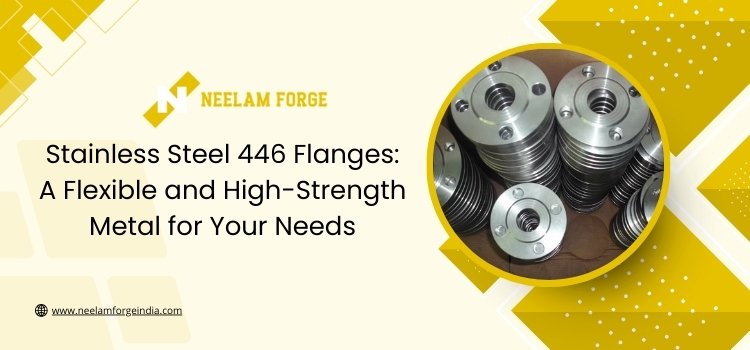
When engineering pipelines for extreme environments, standard materials often warp, scale, or corrode under pressure. This is where Stainless Steel 446 Flanges become indispensable. Recognized in the industry by its numerical designation UNS S44600, Stainless Steel 446 Flange is a high-chromium, ferritic stainless steel alloy engineered specifically to handle immense heat and harsh chemical exposures.
Whether you are designing a petrochemical refinery, upgrading power plant boilers, or constructing severe-duty industrial heaters, utilizing SS 446 flanges ensures your infrastructure maintains structural integrity and leak-proof safety over decades of operation.
What Makes Stainless Steel 446 a High-Performance Alloy?
The secret to the longevity of 446 stainless steel flanges lies in their unique chemical composition. Because the alloy contains an exceptionally high amount of chromium (typically between 23% and 27%), it possesses a natural, heavy-duty defense mechanism against thermal and chemical degradation.
Key Material Characteristics:
- Extreme Heat Resistance: Operates safely in continuous temperatures up to 1093°C (2000°F) without melting or structural yielding.
- Oxidation and Sulfidation Immunity: The high chromium content prevents the scaling and degradation typically caused by sulfur-bearing gases at high temperatures.
- Exceptional Dimensional Stability: Maintains its shape and structural strength despite constant thermal cycling.
- Low Thermal Expansion: Crucial for maintaining tight, leak-free flange joints during intense heating and cooling phases.
Major Industrial Applications for SS 446 Flanges
Because of their distinct thermal properties, stainless steel 446 pipe flanges are specifically sourced for heavy industries where standard austenitic steels (like 304 or 316) would fail.
1. High-Temperature Furnace & Boiler Systems
In facilities that rely on mass heat generation, you cannot risk a breached pipe joint. SS 446 flanges are the primary fitting choice for:
- Industrial furnace components and burners.
- High-capacity heat exchangers.
- Boiler baffles and thermal processing units.
- Petrochemical heaters and exhaust systems.
2. Corrosion-Prone and Chemical Environments
Beyond just heat, UNS S44600 flanges offer formidable resistance to corrosive elements, making them highly effective in:
- Chemical processing machinery.
- Gas turbines handling volatile fuels.
- Oil refineries and distillation pipelines.
- Desalination plants processing seawater.
SS 446 vs. Other Stainless Steel Grades (304, 316, 410)
Why choose SS 446 over more common grades like 304 or 316? The answer comes down to extreme temperature handling and cost-efficiency over time.
- Higher Heat Tolerance: While SS 304 and 316 scale and weaken significantly above 800°C, SS 446 easily withstands continuous exposure up to 1100°C.
- Incredible Scaling Resistance: Thanks to its ~27% chromium makeup, 446 massively outperforms 410 and 316 in environments rich in oxidizing sulfur gases.
- Ferritic Stability: Being a ferritic alloy, SS 446 resists stress-corrosion cracking much better than standard austenitic grades, making it safer for highly pressurized industrial settings.
The Structural Benefits of SS 446 for Large Construction Projects
For project managers and architects designing major infrastructure, procuring high-strength materials is a matter of both safety and economics. Investing in high-temperature stainless steel flanges delivers massive long-term benefits:
- Drastically Reduced Downtime: Piping networks won’t need to be shut down frequently to replace melted or scaled fittings.
- Cost-Efficiency: While the upfront cost of SS 446 is higher than standard carbon steel, the decades of specialized, maintenance-free operation result in huge financial savings.
- Crack Resistance: The alloy’s ability to handle extreme thermal expansion prevents catastrophic cracking under high pressure.
Conclusion
When your piping infrastructure demands uncompromising performance in blisteringly hot or chemically aggressive environments, Stainless Steel 446 Flanges are the definitive solution. Their high chromium content, incredible oxidation resistance, and unmatched thermal stability make them an essential asset for construction heads, heavy-duty contractors, and engineering architects striving to build zero-fail industrial systems.
FAQs
Q1. What is the maximum operating temperature for an SS 446 flange?
Stainless Steel 446 flanges are specifically engineered to withstand extreme heat, functioning exceptionally well in continuous operating temperatures up to 1093°C (2000°F) without scaling or yielding.
Q2. Can Stainless Steel 446 Flanges handle highly corrosive chemicals?
Yes. Thanks to a massive chromium concentration of up to 27%, SS 446 exhibits outstanding resistance to corrosive acids, wet conditions, and sulfur-bearing gases commonly found in chemical processing plants.
Q3. Why is SS 446 considered better than SS 316 for certain pipelines?
While SS 316 is an excellent general-purpose alloy, it is austenitic and susceptible to stress-corrosion cracking and scaling at extreme temperatures. SS 446 is a ferritic alloy that provides far superior oxidation and sulfidation resistance in environments exceeding 800°C.
Ready to fortify your project with high-temperature piping solutions?
Ensure the safety and longevity of your infrastructure by choosing the best materials on the market. Contact us today or reach out for a quick quote at sales@neelamforgeindia.com to secure premium-grade Stainless Steel 446 Flanges for your next major installation.