
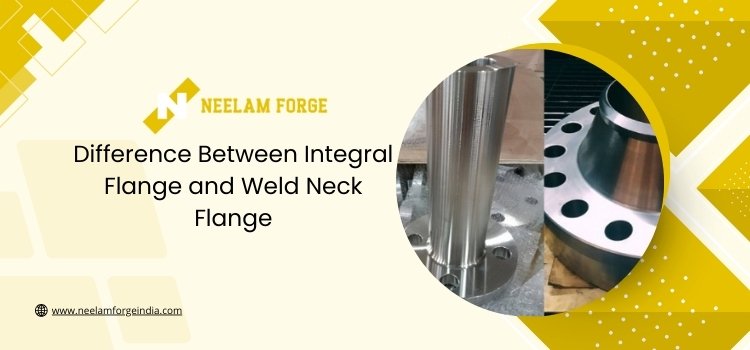
Understanding the difference between Integral Flange and Weld Neck Flange designs is absolutely critical when engineering industrial piping and high-pressure vessels. A single incorrect choice can drastically impact the long-term safety, durability, and financial cost of an entire facility. Consequently, comparing these two high-performance flanges is a topic heavily debated by project managers, architects, and piping engineers handling large-scale oil, gas, and power generation infrastructure.
Both integral flanges and weld neck flanges are engineered to survive highly demanding service environments. However, they possess distinct differences in their physical construction, stress distribution capabilities, installation methods, and overall cost. Understanding exactly where each flange excels prevents premature pipeline failures and highly avoidable maintenance shutdowns. In this technical guide, we break down the definitive difference between Integral Flange and Weld Neck Flange architecture so you can make risk-free, cost-effective procurement decisions.
What is an Integral Flange?
Unlike standard flanges that are bolted or welded onto a pipe, an integral flange is forged or cast as a single, continuous solid piece directly with the pipe, valve, or equipment nozzle. Because there is no weld seam connecting the flange to the pipe, it acts as one uniform structure, providing unparalleled structural rigidity.
Key Characteristics of Integral Flanges:
- Single-Piece Fabrication: Manufactured entirely as a continuous component of the pipe or nozzle.
- Zero Weld Joints: Eliminates the weakest point of a standard flange connection.
- Maximum Stress Resistance: Provides exceptional resistance to severe cyclic loading and extreme vibrations.
- Primary Applications: Highly critical chemical reactors, deep-sea offshore platforms, and severe-pressure vessels.
What is a Weld Neck Flange?
A weld neck flange is universally recognized as the most popular heavy-duty flange in modern industrial piping. It features a distinct, long tapered hub (the “neck”) that is butt-welded directly to the adjoining pipe. This tapered neck is engineered to seamlessly transfer structural stress away from the flange face and down into the pipe wall.
Key Characteristics of Weld Neck Flanges:
- Tapered Hub Design: The long neck perfectly distributes mechanical stress and reduces pressure concentration at the base of the flange.
- Butt-Welded Connection: Requires a full penetration V-weld to securely attach the flange to the pipe.
- High-Pressure Resilience: Capable of handling massive fluctuations in both pressure and sub-zero temperatures.
- Primary Applications: Oil and gas pipelines, high-pressure refineries, and commercial thermal power plants.
Difference Between Integral Flange and Weld Neck Flange: Core Metrics
To determine the best fit for your infrastructure, it is critical to compare these two components across three major industrial metrics: structural strength, installation complexity, and overall cost. The difference between Integral Flange and Weld Neck Flange engineering dictates their final application.
1. Construction Strength and Stress Distribution
- Integral Flange Strength: Because it is cast as a single piece, an integral flange offers the absolute maximum level of mechanical strength. It has virtually zero stress concentration points, making it the safest option for extreme environments where joint failure is catastrophic.
- Weld Neck Strength: While highly durable, a weld neck flange inherently relies on the physical integrity of its butt-weld. Although the tapered hub smoothly transfers stress, the welded joint will always be slightly weaker than a single-piece integral forge.
2. Installation and Maintenance Complexity
- Integral Flange Installation: Because it is built directly into the equipment, integral flanges require complex manufacturing and cannot be easily modified or replaced on-site. However, because there is no weld seam, they require far less routine radiographic inspection.
- Weld Neck Installation: Highly versatile. Standard weld neck flanges are easily aligned, butt-welded, and replaced by skilled technicians during routine plant maintenance. However, the weld joint requires strict, ongoing non-destructive testing (NDT) to ensure long-term pipeline safety.
3. Upfront Cost vs. Lifecycle Value
- Integral Flange Cost: Requires extremely expensive, custom machining and massive forging capabilities, resulting in a significantly higher upfront investment.
- Weld Neck Cost: Highly economical. Because they are mass-produced to standard ASME dimensions, weld neck flanges offer a significantly lower upfront cost and are readily available for immediate global procurement.
Comparison Summary: Integral vs. Weld Neck Flange
| Specification | Integral Flange | Weld Neck Flange |
|---|---|---|
| Manufacturing Process | Cast/Forged as a single piece with the nozzle | Forged separately, then butt-welded to the pipe |
| Structural Strength | Absolute Maximum (No weld weak points) | High (Relies perfectly on weld integrity) |
| Stress Distribution | Evenly distributed throughout the solid body | Transferred through the tapered hub to the pipe |
| Installation Flexibility | Low (Custom engineered, hard to replace) | High (Standardized, easy to weld and replace) |
| Overall Cost | Very High | Highly Economical |
Which Flange Should You Choose?
Ultimately, understanding the difference between Integral Flange and Weld Neck Flange designs dictates where they should be deployed in the field.
- Specify an Integral Flange when: You are engineering highly volatile pressure vessels, critical chemical reactors, or offshore platforms where extreme pressure, temperature, and cyclic loading make structural failure completely unacceptable regardless of cost.
- Specify a Weld Neck Flange when: You are constructing massive miles of high-pressure commercial pipelines. They offer the absolute perfect balance of elite structural strength, standard availability, and overall project cost-efficiency.
Conclusion
The core difference between Integral Flange and Weld Neck Flange technology boils down to single-piece reliability versus welded versatility. The seamless, one-piece construction of an integral flange provides unmatched safety in zero-fail environments. Conversely, weld neck flanges deliver phenomenal high-pressure performance with much simpler installation logistics, cementing them as the undisputed backbone of modern industrial piping.
FAQs
Q1. Which is physically stronger: an integral flange or a weld neck flange?
An integral flange is unconditionally stronger. Because it is forged as a single, continuous solid piece with the pipe or equipment nozzle, it completely eliminates the weld joint—which is naturally the weakest point of any standard piping connection.
Q2. Why are integral flanges used much less frequently than weld neck flanges?
Integral flanges are prohibitively expensive to manufacture and lack on-site flexibility. Weld neck flanges offer a fantastic compromise of extreme high-pressure strength, standard global availability, and cost-efficiency, making them the superior choice for sprawling pipeline networks.
Q3. Does the extreme cost of an integral flange justify its use in piping?
Yes, but only in extremely specialized applications. In environments like nuclear cooling loops, deep-sea oil extraction, and lethal chemical processing—where a weld failure would result in catastrophic loss of life or environmental ruin—the extreme cost of a seamless integral flange is absolutely justified.
Ready to procure premium flanges for your next major industrial project?
Don’t leave your pipeline’s integrity to chance. Partner with experienced forging experts to secure the exact flanges you require. Contact us today or email our technical sales team at sales@neelamforgeindia.com for expert pipeline guidance, technical support, and competitive global infrastructure quotes.