
Choosing Between a Slip On Flange and a Lap Joint Flange
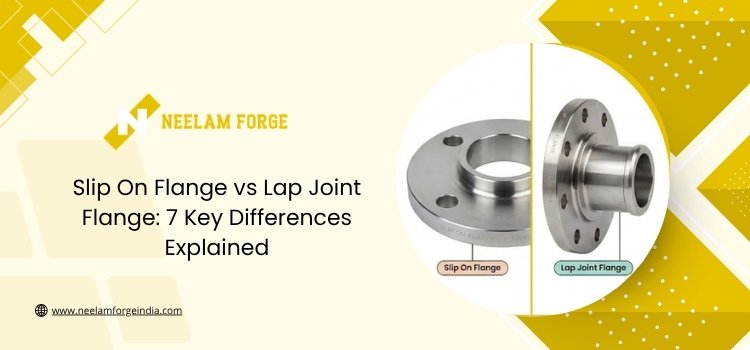
A piping engineer will find himself in the same situation at the design table over and over: between a slip on flange vs lap joint flange, which is right for the job? Both types are among the most frequently referenced flange types in ASME B16.5, and both are bolted in the same manner during installation. But the resemblance stops there. Slip-on flange welds interface directly with the pipe and transfer the pressure of the process fluid through itself, whereas lap joint flange welded joints float on a separate stub end and never come in contact with the process fluid itself. This one design difference affects the way they are manufactured, inspected, maintained, and priced. Whether you are in charge of procurement or site engineering for carbon steel, stainless steel, or a high-nickel alloy piping system, it is important to grasp this distinction early in the project, as it can lead to rework and specification issues later.
Key Takeaways
- A slip on flange slides over the pipe and is welded on both the inside and outside to ensure pressure containment.
- A lap joint flange is free to rotate on a stub end, but does not carry any direct pressure load.
- Slip on flanges are less expensive and faster to weld, while lap-joint flanges are more expensive but make it easier to align the bolts and are better for alloy piping economies.
- Lap joint flanges are the standard choice when the piping material is expensive, such as stainless steel or exotic alloys, because the flange itself can be reused on low-cost carbon steel piping.
- Neither flange type is rated as high as a weld neck flange, so pressure class and service conditions still decide the final selection.
What Is a Slip On Flange?
Slip on flange, also called SORF (slip on raised face), is a flat-faced or raised-face flange that is placed on the outside diameter of the pipe and then welded. The installer welds the flange inside and out, in the hub, and at the face, which provides good strength while keeping fabrication simple.
Since the pipe only needs to be cut square and inserted partially into the flange bore, alignment is quickly done on site. The reasons for the continued popularity of slip on flanges in low- to medium-pressure piping, water systems, HVAC, and general industrial applications where extreme cyclic loading is not a primary consideration.
Slip On Flange: Strengths and Trade-Offs
Slip on flanges gain popularity primarily due to ease of installation and lower installation cost. Here are some practical tips:
- It requires less precise pipe cutting than a weld neck flange because the pipe end is located in the bore of the flange and not butting against it.
- Uses roughly 50% less welding material compared to a butt-welded weld neck flange of the same size, which shortens welding time on large projects.
- Has a reduced fatigue life when subjected to cyclic or shock loading, due to the double fillet weld forming a discontinuity in the pipe wall which concentrates stress.
- Is in general accepted up to the lower and mid pressure classes (usually Class 150 to Class 300 in most plant piping). The limits depend on the code, service, and design pressure.
Where budgets are tight, and the service is steady-state rather than highly cyclic, a slip on flange is often the pragmatic choice.
What Is a Lap Joint Flange?
A lap joint flange, also known as a loose flange, functions like two pieces. A short pipe section with a flared or radiused end, known as a stub end, is welded to the process pipe. The lap joint flange then slides over the stub end and rotates freely against the flared back face. The pressure is only on the stub, and the flange is pressureless, with no direct weld to the pipe.
The main advantage of the lap joint flange is its rotating mechanism; the flange is easily aligned with the bolt holes, even if the pipe run is slightly angularly misaligned. This single feature can save valuable time in the field during assembly, particularly for large-diameter and/or awkward pipe routing.
Lap Joint Flange: Strengths and Trade-Offs
Lap joint flange gives a little pressure sacrifice in exchange for flexibility and cost savings over the long term:
- Allows the flange to be reused. If the piping system is to be removed, the lap joint flange (usually a low-cost carbon steel piece) can be removed and reused on another stub end, and only the stub end is replaced.
- Costs significantly less in material expenses for stainless steel, duplex, or nickel alloy piping, as the more expensive alloy can be used only in the thin stub-end portion of the pipe, while the thicker flange body portion can be standard carbon steel.
- Simplifies bolt-hole alignment with a free-rotating design, reducing field fit-up time.
- Rates are lower in pressure and fatigue performance than a slip on flange or weld neck flange, because the load path is through the stub end and the flange only clamps; it does not directly seal.
Works best under low-pressure, non-critical, or alloy-rich piping conditions where reusability and cost are more important than the slight loss of mechanical properties.
Slip On Flange vs Lap Joint Flange: Side-by-Side Comparison
| Parameter | Slip On Flange | Lap Joint Flange |
| Contact with process fluid | Direct, flange body is welded to pipe | Indirect, only the stub end touches fluid |
| Welding required | Two fillet welds (inside and outside) | One weld, on the stub end only |
| Pressure rating | Moderate, generally lower than weld neck | Lowest of the common flange types |
| Alignment during installation | Fixed once welded | Rotates freely for easy bolt alignment |
| Reusability | Not reusable once welded and cut | Flange can be reused with a new stub end |
| Best-fit material savings | Limited | High, ideal for expensive alloys |
| Typical applications | General industrial, water, low-cyclic service | Alloy piping, systems needing frequent dismantling |
Where Each Flange Type Fits Best
In moderate-service, low-vibration applications, a slip on flange will handle most carbon steel piping at a lower installed cost. It is a familiar, well-understood component, and most fabrication shops can weld and inspect it quickly.
A lap joint flange becomes necessary under other conditions: when piping is built from stainless steel, duplex, or high-nickel alloys; when systems must be inspected or dismantled periodically; or when slight misalignment of the pipe limits the ability to align the bolt holes with a fixed flange. On long runs of alloy pipe, this can significantly reduce project costs by allowing use of the existing carbon steel flange body, with only the alloy stub end replaced.
In addition to the above, it will also depend on the applicable design code, the applicable pressure class, the temperature, and whether thermal cycling or vibration is part of the application; it is worth checking against ASME B16.5 and the piping specification in the project before selecting either choice. Buyers looking for either type can check Neelam Forge India’s Slip On Flanges and Lap Joint Flanges ranges across grades and sizes, and, for comparison with a common alternative, consult “Slip On Flange vs Socket Weld Flange: 7 Critical Differences Explained.”
Conclusion
The design of a slip on flange vs lap joint flange is subjective and depends on how the flange is connected to the pipe and what is most important to the project. A slip is a flange welded to the pipe that provides a simple, moderately priced connection and is appropriate for general industrial and low-cyclic service. A lap joint flange sits on a separate stub end with a corresponding cost, but it provides easy bolt alignment and reusability of the flanges, and it is a good choice in alloy piping when material is important. Checking the pipe material, pressure class, and the frequency at which the joint will be taken apart will typically indicate the correct flange type for the job.
FAQs
Q1. Can a lap joint flange handle the same pressure as a slip on flange?
No. A lap joint flange typically has a lower pressure rating than a slip-on flange of the same size and class because the load is not actually transferred through the flange; the flange simply clamps against the stub end.
Q2. Why do stainless steel piping systems often use lap joint flanges instead of slip on flanges?
The stub end is made from an expensive alloy, and the larger part of the flange body can be made from inexpensive carbon steel. This helps to reduce material cost without sacrificing alloy contact with the process fluid.
Q3. Is a slip on flange easier to install than a lap joint flange?
A lap joint flange is easier to align during bolt-up because it rotates freely around the stub end, whereas a slip-on flange has only one piece and requires two fillet welds. The overall installation speed depends on the size, alloy, and site conditions.
Still unsure which one fits your specification? Contact us or write to sales@neelamforgeindia.com for grade selection and pricing support.