
Why Do Engineers Compare a Slip-On Flange and a Blind Flange?
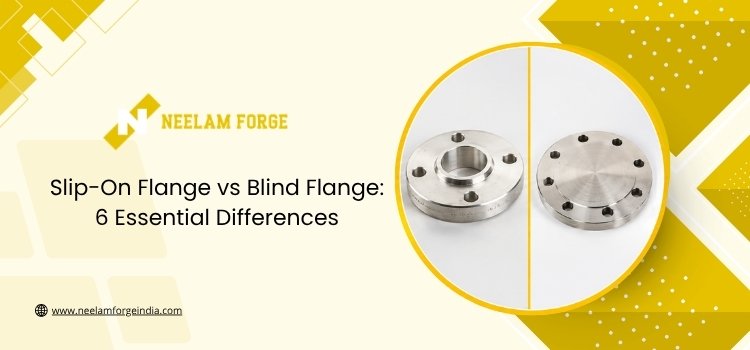
Open almost any piping material list, and you will find both flanges. That’s why the slip-on flange vs blind flange question keeps coming up for buyers, estimators, and site engineers. At the same size and pressure class, they share the same outside diameter, bolt circle, and bolt holes, so on paper they look interchangeable.
They are not. One connects to something, and the other closes a pipe. The wrong one wastes money at best and creates a leak path at worst.
This guide explains how each flange is built, where to use it, and how to choose between them. ASME B16.5 covers both types from NPS 1/2 to 24, so the comparison applies to most common piping projects.
What Is a Slip-On Flange?
A slip-on flange has an inside diameter slightly larger than the pipe’s outside diameter. The pipe slides into the flange and is held by two fillet welds, one inside and one outside.
Contractors like it for a few simple reasons:
- It is less expensive than a weld neck flange.
- Alignment is simpler, since the pipe can be placed in position before welding.
- Pipe ends need not be precisely beveled.
The trade-off is strength. Piping references commonly put a slip-on flange at about two-thirds of the internal pressure strength and one-third of the fatigue strength of a weld neck flange.
It is made with a raised or flat face, with or without a hub. Hubless versions cost less but give up some strength. If you’re weighing other types, our guides to slip-on flange vs socket weld flange and slip-on flange vs lap joint flange go deeper.
What Is a Blind Flange?
A blind flange is a solid disc with a bolt circle and no bore. It bolts onto a pipe end, valve, or vessel nozzle to seal it. ASME B16.5 allows blind flanges to be made from cast, forged, or plate material.
Since nothing passes through the disc, it carries the full load across its face. As size increases, blind flanges become some of the most highly stressed flange types, so thickness and bolting matter more. In corrosive service, stainless grades are common, and our guide to SS 316L blind flanges explains why.
Slip-On Flange vs Blind Flange Difference
The biggest slip-on flange vs blind flange difference is purpose. A slip-on flange joins two pipes. A blind flange closes the line. Here are the six main differences.
| Feature | Slip-on Flange | Blind Flange |
| Bore | Open bore, pipe slides in | Solid disc, no bore |
| Main function | Inline joint where flow continues | Closes a pipe end, nozzle, or valve outlet |
| Installation | Fillet welded to the pipe | Bolted to a mating flange with a gasket |
| Stress profile | Moderate, suits low to medium pressure | High bending stress on the disc, especially in large sizes |
| Pressure classes (B16.5) | Not made in Class 2500, and only in small sizes at Class 1500 | Made in every class up to 2500 |
| Access | Permanent flow path | Can be unbolted to open the line |
Slip-On vs Blind Flange Dimensions (ASME B16.5)
At the same size and class, the two flanges match on outside diameter and thickness. The slip-on simply adds a hub and a bore. That is why a blind flange bolts straight onto a slip-on flange.
| NPS | Class | Outside Diameter (mm) | Thickness (mm) |
| 2 | 150 | 150 | 19.1 |
| 2 | 300 | 165 | 22.3 |
| 3 | 150 | 190 | 23.9 |
| 3 | 300 | 210 | 28.6 |
| 6 | 150 | 280 | 25.5 |
| 6 | 300 | 320 | 36.6 |
Class 150 and 300 thicknesses include the 1.6 mm raised face. From Class 400 up, the 6.35 mm raised face is added on top. Values are from the slip-on flange tables and blind flange tables for ASME B16.5. Check the current standard before you finalize a drawing, and use our flange dimensions chart for other sizes.
Slip-On Flange vs Blind Flange Applications
Slip-on flanges suit systems with moderate pressure, moderate temperature, and modest load swings:
- Water supply and cooling water lines.
- Compressed air and utility piping.
- Fire protection and general plant piping.
They are not suited to severe cyclic service or continuous vibration. Weld neck flanges are the better choice there, and our guide to high-pressure flanges explains what to use instead.
Blind flanges are used where a line needs to end or stay leak-tight:
- Line ends and future tie-in points.
- Vessel and tank nozzles.
- Isolating valve and pump connections.
- Hydrostatic test setups.
Slip-On Flange vs Blind Flange Uses in Practice
The two parts often work as a pair. Take a cooling water header with a spare branch. Crews weld a slip-on flange to the branch and bolt a blind flange onto it. Later, the blind comes off and the branch connects to new equipment without cutting the pipe.
During commissioning, blind flanges isolate sections for pressure testing. During shutdowns, the same blinds isolate equipment and work areas. Slip-on flanges do the daily work of joining straight runs and connecting pipe to valves, pumps, and vessels.
How to Choose the Right Flange?
Three questions settle most decisions:
- Must this point carry flow or stay closed? Flow needs a slip-on flange. A closed end needs a blind flange.
- What are the pressure class, temperature, and cycling conditions? Heavy cycling, or a class where slip-on is not offered, calls for a weld neck flange.
- Will someone need to open this point later? A bolted blind flange allows that, unlike a welded cap.
Whatever you choose, match size, pressure class, facing, and material between mating flanges.
Conclusion
Both flanges matter in a piping system, but for different reasons. The slip-on flange connects pipe economically in moderate-duty lines. The blind flange seals ends, isolates equipment, and keeps future access open.
Once you frame the slip-on flange vs blind flange choice as join versus close, it becomes much easier to specify.
FAQs
Q1. Can a blind flange be used with a slip-on flange?
Yes. When the size, pressure class, facing, and bolt pattern match, the blind flange bolts directly onto the slip-on flange, with a gasket between them to seal the line.
Q2. Is a slip-on flange suitable for high-pressure lines?
Usually not. Its strength under internal pressure is about two-thirds of a weld neck flange, and it is not preferred for high-pressure or cyclic service. It is also not made in Class 2500, so weld neck flanges are used in these applications.
Q3. Is a slip blind the same as a blind flange?
No. A blind flange bolts onto the end of a line. A slip blind, such as a spade or spectacle blind flange, is a plate fitted between two flanges to isolate a section for maintenance.
Neelam Forge India supplies stainless steel slip-on and blind flanges from Mumbai. Reach us through the contact page or email sales@neelamforgeindia.com.